

In the world of agility, we’ve learned to use the concept of value streams as both a conceptual and organizational map to understand how an organization creates value for its customers. It was a necessary and useful revolution that helped us move beyond the siloed, function-based structures that had slowed down collaboration and agility for decades. But now, we’re heading into a new discontinuity…

The rise of Agentic AI, combined with the explosion of hyper-personalized customer journeys enabled by generative technologies, is opening up entirely new scenarios. It’s no longer just about efficiency — it’s about completely redesigning the very idea of how value is delivered.
The value streams we know today are becoming obsolete. What lies ahead is the age of adaptive value streams.
From Value Streams to Value Networks
In his latest book, Human Robot Agent, Jurgen Appelo explains how the nature of organizational processes is shifting. From predictable, linear flows, we’re moving toward modular, adaptive networks, reconfigurable in real-time thanks to AI agents capable of acting autonomously at many points in the value chain.
Think about it: until now, we’ve mapped our processes as chains. But in a world where AI can:
-
dialogue with the customer to understand their needs in real time,
-
generate value through products and services and delivering content in real time,
-
and, within the process of product development, test, learn, and adapt autonomously,
…does it still make sense to think to Value Stream in terms of “chains” of predefined nodes?

Or should we start speaking of adaptive ecosystems of value creation, where humans and AI agents collaborate and coordinate in real-time?
The Old Functional Model is Reaching Its Limits
This new paradigm brings us face to face with a truth many already sensed:
Function-based organizations are a thing of the past
Even today they struggle to keep up with the market’s speed; tomorrow, they’ll be genuine bottlenecks.
To be clear, we are not saying that being expert in certain functions or specialties is outdated or no more valuable.
The contrary, we think that people need to continue specializing (in more than one area), but should they remain in a function? Or shouldn’t they form impromptu cross-functional teams as needed, swarming around bottlenecks or opportunities, and join in communities of practices or communities of interest the grow their knowledge? Why?
-
AI agents do not “belong” to a department.
-
They can be activated and deactivated wherever needed, on-demand.
-
They can work simultaneously across tasks, coordinating with other agents or humans.
This makes organizational flexibility not an option, but a necessity.
Are you Already Using Value Streams? Ehm…
You might think: “But we’ve already implemented value streams. We have cross-functional teams, we’re focused on customer experience, we’ve shortened decision cycles.”
Great. But shortly it won’t be enough anymore.
The integration of AI agents into workflows will also change how cross-functional teams operate:
-
Some steps currently performed by people will be handled by AI agents (of course within precise and specific boundaries where decision making is subjected to rules and thresholds defined by humans).
-
The human role will mainly shift: from executors to orchestrators of business capabilities available in platforms and AI Agents.
-
The ability to integrate AI into daily work will become a key success metric.
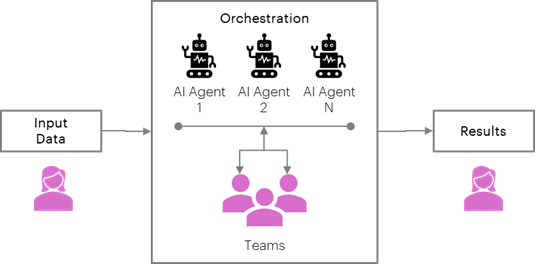
In short, it’s no more just about structure, but about flexibility, skills, and mindset.
The Era of Adaptive Value Streams Has Just Begun
Adaptive value streams aren’t just a trendy term. They’re an emerging reality, made of:
-
Distributed orchestration: humans guide, coordinate, and supervise specialized AI agents.
-
Selective autonomy: AI handles repetitive, analytical, or high-volume steps autonomously.
-
Dynamic personalization: each customer receives a real-time experience tailored to their signals, behaviors, and interactions.
-
Continuous reengineering of value: the stream constantly adapts to external conditions, emerging data, and system feedback.
Value Stream Mapping: A Key Tool to Prepare
In my previous blog post “AI: Best Friend or Worst Enemy? It Depends on Your Bottlenecks!” I wrote about a study released in February by the Business Agility Institute named “From Constraints to Capabilities AI as a Force Multiplier”.
That report highlighted actual numbers of AI as a force multiplier for different organizational dimensions, but also the fact that AI brought as it is in organizations, can make things worse because it magnifies company’s bottlenecks and fragilities.
To navigate this transition, we thing that one of the most powerful tools at our disposal is the Value Stream Mapping (VSM) technique.
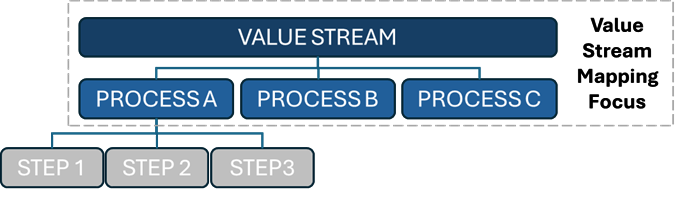
Now more than ever, we need to:
-
Visualize where value is created — and where it’s lost.
-
Identify bottlenecks and unnecessary steps.
-
Make wait times, handovers, and waste explicit.
-
Design a lean and adaptive version of the stream, ready to host AI agents in the right spots.
When used well, VSM is not just an analysis tool, but a driver of continuous transformation.
It becomes the lens through which we dynamically understand our organization as the context evolves. And it’s also the compass we use to navigate this new hybrid world where human+AI co-create value.
An intelligent and timely use of that technique, could help achieving those results:
✅ Redesign governance: lighter, faster, built for experimentation.
✅ Simplify workflows: remove bottlenecks before bringing in AI, not after.
✅ Promote systems thinking: every change to one node can impact the whole network.
✅ Build learning organizations: environments where continuous learning — especially from failure — is encouraged.
Conclusion: Orchestrating the Future
The future is no longer a straight path to efficiency. It’s a dynamic network, where every node could eventually change shape, function, and meaning according to punctual customer needs. Where value isn’t transported — it’s created and re-created continuously, in partnership with digital agents.
The future of value streams will be shaped by those who can blend logic with imagination.
Efficiency with empathy. AI with agility.
Content: Human-Generated + AI Processing

