

Recently, on Linkedin, I shared a reflection on a paradox: many organizations operate as if they were athletes constantly training in Zone 5—maximum intensity, maximum effort, but sustainable only for a very short time.
In endurance sports, coaches have long known that this is the fastest way to cause burnout and decline in performance. And yet many businesses remain for too long in “Zone 5”.

To understand this parallel between sport and business, let’s have a first look at training zones and ho do they work in sports and then we see how they translate into business practice. In doing this we get deeper in reasoning on the tendency of companies to permanently stay in Zone 5 and why it happens, how does it costs to organizations and how to start building new healthy habits.
The Five Training Zones – From Sports to Business
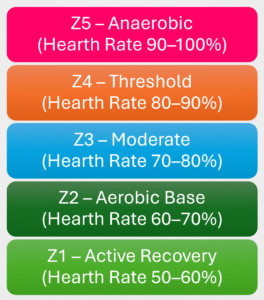 Athletes train by alternating across five effort zones that are calculated around each athlete’s max hearth rate.
Depending on what type of sport you do practice (endurance, sprints, etc.) training in those zones of course can differ.
Each zone serves a different purpose, and the real improvement comes not from always pushing at maximum intensity, or remaining mainly in one of the zones, but from managing the balance across them.
The same sport principles can apply to organizations in business and that keeping this into account creates long-lasting benefits.
-
Zone 1 – Active Recovery
🚴 In sports: very light effort, active recovery, regeneration.
🏢 In business: this is the equivalent of organizational renewal where to make space for reflection, learning, retrospectives, and decompression time. This is far from being wasted time, these moments actually build resilience, prevent burnout and prepare teams for new product releases or project cycles. -
Zone 2 – Aerobic Base (Sustainable Focus)
🚴 In sports: low-to-moderate intensity, this helps creating aerobic base that makes endurance possible.
🏢 In business: the foundation is State of Flow, Deep Work, where leaders need to setting the stage for their teams for protected focus time, reduced context switching, and clarity on priorities. Teams spending more time in this zone see higher productivity and decision quality. -
Zone 3 – Moderate (The Grey Zone)
🚴 In sports: medium-high intensity, it strengthen aerobic and endurance attitudes; however, if prolonged, it could feel like hard work but without real tangible progress: usually it’s too hard for recovery, too soft for gains.
🏢 In business: the “busy-ness zone” usually made of endless status meetings, overloaded backlogs, continuous change of priorities, multitasking. Energy is consumed, but progress is minimal. If we go this way, we are not building strength, endurance or resilience; we re paving the way to people frustration. -
Zone 4 – Threshold (Peak Intervals)
🚴 In sports: high intensity, short bursts that stimulate adaptation.
🏢 In business: this is where teams deliver strategic pushes such as product launches, critical deadlines, transformation milestones. Powerful, indeed very powerful, but only if used with moderation and preparation. -
Zone 5 – Anaerobic (Maximum Intensity)
🚴 In sports: full effort, only sustainable for a few minutes, reserved for competition.
🏢 In business: the equivalent can be transposed to crisis mode as when dealing with firefighting, emergencies, war rooms. Sometimes necessary, but not at all sustainable.
As said, athletes do improve by swimming, cycling, running through these zones intelligently.
Organizations, too, must learn that true performance doesn’t come from constant Zone 5 (or even Z4) effort but from orchestrating the right balance across all zones.
Why Companies End Up in Zone 5
So why do so many organizations operate as if Zone 5 were the only option?
Here a list of five possible systemic causes:
- Obsession with short-term results: Pressure from shareholders or markets leads leaders to push harder and harder, every quarter. More hours, more activities, more projects… creating the illusion of growth, while at the end not creating real value.
- Culture of visible effort: Effort is mistakenly rewarded more than impact. Endless meetings, late-night emails, and packed calendars are confused with “performance”.
- Misalignment between strategy and capacity: Top-down objectives are often disconnected from the actual productive capacity of teams. Demand is not matched with actual available effort and stretch goals become the only norm.
- Lack of cycles and recovery. In sports, recovery is actual training. In business, reflection, retrospectives, or decompression time are often seen as “wasted time”. No recovery means having systems in permanent alert mode (cortisol hormone in continuous circulation which provoke damage to health).
- Reactive rather than anticipatory leadership: When leaders operate reactively, every issue becomes urgent. This creates a constant emergency mode, creating intensity without strategy. Summarizing in one Word? Waste.
The evidence of the damage provoked by these behaviors is striking.
Burned-out employees are 2.6 times more likely to be searching for another job, and managers — those vital multipliers — are especially vulnerable to burnout-driven exits (Hubstaff, CultureMonkey). Gallup finds that 42% of voluntary turnover could have been prevented with timely management intervention (Gallup).
Engagement tells a similar story. Globally, disengagement is estimated to cost the business world up to $8.8 trillion annually in lost productivity (FranklinCovey). By contrast, highly engaged teams are up to 43% more productive and show significantly lower turnover (Wikipedia).
The picture is clear: organizations that normalize constant overload create fragility and erode long-term value.
 But the inverse is equally true. Research commissioned by the U.S. Chamber of Commerce found that companies investing in employee health and well-being generate an average 47% return on every dollar spent (Cigna/Avalere).
In other words: ignoring the balance across zones leads to attrition, disengagement, and lost productivity, while managing it deliberately builds strategic resilience and financial outperformance.
Learning from Sports: The Alternative Paradigm
Sports science has known for decades what business is still learning: performance is not about pushing harder, but about managing intensity through zones and cycles.
-
Training in Zone 2 (sustainable focus and effort) builds endurance and resilience.
-
Spend value time in Zone 3 create progress but remaining there too long (the “grey zone”) drains energy without creating real tangible and significative progress. What about leveraging here Agentic AI?
-
Zones 4 and 5 are necessary peaks, but they must be carefully planned and limited in duration.
- Allot time for recovering Zone 1 (learning, reflecting and setting the base for improvement) and prepare for next cycle
This is not “just” about protecting employee well-being (which is paramount).
It’s about creating organizations that can sustain performance, innovate consistently, and deliver value at speed without self-destructing.
Operating in Zone 5 may deliver short-term wins, but at the expense of long-term success.
No CEO would ever expect an athlete to sprint a marathon. Yet many organizations behave as such.
As leaders, our role is not to drive constant pressure; it’s to design pulsed performance systems.
-
Create protected time for focus (Z2).
-
Eliminate the inefficiency of the grey zone (Z3).
-
Plan for high-impact peaks (Z4 and Z5).
-
Safeguard recovery (Zone 1).
That is how you convert effort into performance, and performance into lasting business impact.
Working these days on a specific Leadership Model. Curious? Stay tuned!
Content: Human-Generated + AI Processing

