

Frontrunner, organizations that are strongly pulling ahead, are not advancing fast because they “believe” more than others in a methodology label. They do because they shift the center of gravity: less energy defending predefined forms, approaches or frameworks. More energy pulling in the right capacity (people + agents) around business goals that are clear, measurable, and negotiated with the market.

80% of the global workforce among employees and leaders, say they lack enough time or energy to do their work; however, business does not wait and demands continue to rise.
Some studies show what we feel everyday in our work: employees from all over the world reached their upper limit in terms of productivity:
- Every 2 minutes employees are interrupted by a meeting, email or chat during every work day
- 60% of meetings are ad-hoc ones (called in the moment)
- 15% increase of work messages sent in chats outside the typical “9-to-5” workday
Some studies help us to better understand what the future could be:
- The research from Microsoft 2025 The Year the Frontier Firm Is Born describes companies that activate intelligence “on demand” and reconfigure teams by jobs-to-be-done, are moving fast than others.
- The field experiment The Cybernetic Teammate: A Field Experiment on Generative AI Reshaping Teamwork and Expertise shows how artificial intelligence transforms the core pillars of collaboration (performance, expertise sharing, and social engagement) through a pre-registered field experiment with 776 professionals.
Results are relevant:
|
These results connect very well with what I, standing on the shoulders of some Agile/AI Giants, argued months ago in some of my posts.
In How AI Could Potentially Redefine Agile Dynamics, I wrote about small teams, human–AI collaboration with AI as an active member, and human roles moving toward choices/quality/responsibility.
In Hack Your Agile Feedback Loops I wrote about even tighter feedback cycles (inner/outer loop) and shorter sprints (hyper-sprints).
Finally, in From Chain to Network I highlighted a trend already visible: a move from linear to adaptive value streams, with distributed orchestration and selective autonomy.
Today all this is the reality. Not only it has been studied (see research), it is happening…and that’s accelerating even more.

Six core principles that are changing
It’s time to change and build on the principles of the past, while abandoning old dogmas and beliefs that are no longer of any value today. Six core principles we kept tight for years need to be urgently reviewed:
- The Knowledge Worker
- Cross-functionality
- Small Teams
- T-Shaped Profile
- Scaling Frameworks
- Long-living Teams
Here below some reasoning on how we could rethink them.
From “Knowledge Worker” to “Knowledge Work”
For years we “planned” around people having specific knowledge and competences, their roles and teams’ shape; today it matters to design around the actual work to be done, find the right person and develop the capability to activate on demand those competences through the help of AI.
 Peter Drucker in 1959 described knowledge workers as people whose main capital is their knowledge and expertise and that, in the upcoming years, became the dominant part of the workforce in developed nations.
Today the focus shifts: no more on who holds the knowledge, but on how knowledge work is orchestrated. Humans own intent, judgment, relationships, and ethics; agents handle the repeatable and scalable parts.
The key metric isn’t how many “experts” you have, but how much cognitive work capacity you can activate, with clear quality thresholds and accountability.
The Frontier Firm report turns this into a Work Chart, which organizes people and agents around the work to be done, with decisions, execution, validations, and standards made explicit for each outcome, and into a continuum of agent autonomy with clear human gates.
- ✨ What changes: you don’t need “more heads,” you need more capacity to orchestrate with clear quality criteria. The team is defined by the work, not by the department
- ✅ How to act tomorrow: for each flow, define the Human–Agent Ratio (how many agents, how much autonomy, what human quality gates)
Cross-functionality > “on-demand colleague,” not necessarily on-board
Cross-functionality is a key principle of Agile. It was “built” to reduce waiting and bottlenecks, while increasing innovation.

Today you can get the same effect with AI agents that cover activities typical of other departments, leaving SMEs (subject matter experts) with the task of validating results afterwards.
In The Cybernetic Teammate study, thanks to the help of AI, the solutions become more balanced between technical and commercial aspects; individual + AI reached the quality of a team without AI.
- ✨ What changes: less inter-departmental “ping-pong,” shorter cycle times, and department responsibility moves to gates (brand, legal, safety)
- ✅ How to act tomorrow: prepare a practical guide that treats AI like an external colleague: when to use it, what it must deliver, who checks it and by when, and when it must stop and request a human review
Team size: the Minimum Viable Squad (MVS) gets smaller
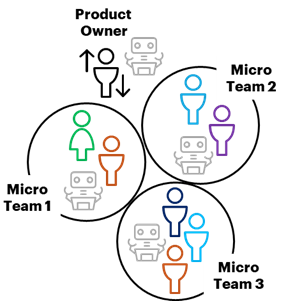 The “up to 8–10 people” Scrum guideline was of course useful 20 years ago, but when parts of the work can be handled by agents, is that necessary anymore? The effective MVS becomes 1–3 people + AI agents.
In The Cybernetic Teammate experiment, micro-pairs working on real problems with AI more often produced excellent solutions; individual + AI matched the quality of a team without AI. The Frontier Firm blueprint explicitly describes human–agent teams that run end-to-end phases with targeted supervision.
- ✨ What changes: more experiments per unit of time, lower coordination cost, higher focus
- ✅ How to act tomorrow: establish the MVS for each type of challenge and appoint an “Agent Boss” to orchestrate agents, prompts, quality, and metrics
T-Shaped profiles > strong generalists with expertise on-demand
Deep multi-skilling for a single person (T-Shaped) was meant to reduce dependencies and accelerate value delivery. In practice, our experience shows that building such a profile costs a lot and it is unfortunately slow to bring to life.
Today we can keep strong generalists for key choices and bring in on-demand vertical skills with AI agents and quality checkpoints managed by domain experts (SME).
As reported In The Cybernetic Teammate study, non-core professionals with AI achieve results comparable to teams with at least one core job.
- ✨ What changes: less “must” to make everyone super T-shaped, more accelerated learning through AI with quality protected by human-gates
- ✅ How to act tomorrow: update the skill matrix by separating decision tasks (humans) and execution tasks (agents with clear criteria). Train people in prompting, orchestration and trade-off decision making
Scaling: less heavy frameworks, more outcome-oriented orchestration
If work is done by micro-teams and agents that cover entire “mini-flows”, you will need fewer prescriptive frameworks and more lightweight orchestration. This means shared goals, simple interfaces/standards, and short risk-focused check-ins.

This will open up a new scenario where companies will move from linear value chains to adaptive value networks.
- ✨ What changes: fewer rituals, faster integration among micro-units, governance focused on outcomes rather than ceremonies
- ✅ How to act tomorrow: set simple rules for teams to collaborate (how to hand off work, good-enough quality, shared data, AI policy) and replace fixed meetings with short reviews for active risks management and decision making
Long-living teams: in high-innovation contexts move to crew teams
Long-lived teams work well where the work is continuous over time, such as, for example, maintaining a well-established product.
In high-pressure innovation contexts, it’s rather better to form small crews with clear goals, and dissolve them once done and, yet, compose new ones for new challenges, working in hyper-sprints with nested feedback loops (see Hack Your Agile Feedback Loops).
Stability moves from staffing to shared assets: design systems, libraries, datasets, prompt guidelines, SME checklists, etc.
- ✨ What changes: lower team creation cost, more experiments in less time
- ✅ How to act tomorrow: invest in shared assets and define criteria to create and dissolve micro-teams (when they start, which KPIs they own, when they close, how they work, etc.).
From principle to practice
To avoid philosophy and stay action-oriented, four clear choices need to be made:
- Set Intent and outcomes first (goal, constraints, quality), so AI is correctly driven and does not amplify noise
- Define Human-Agent Ratio for each process that specifies where the agent assists, where it runs autonomously, and where to set human-gate triggers; ie. drafting email (assist), data cleaning (autonomous with review), legal claim (huma-gate)
- Provide minimal but clear roles: the Lead as the person who is leading (decisions, outcomes); the “Agent Boss” being the person who orchestrates agents, define prompts, oversees on quality; the SME as the person who validates and update standards; not to mention Ops and Data people to be pulled-in on demand (e.g., interfaces, datasets, policies).
- Define key and few metrics that matter such as cycle time, measured quality, costs, people’s cognitive load, and exception rate (how often the agent “escalates” to gates).
Closing
Looking back at past debates, I care little, actually nothing, about defending labels, and a lot about shortening the distance between intention and result. One word: value.
The studies above mentioned give two simple messages: with agents, less is often more, and quality improves when humans decide wisely where to rely on AI and where not to.
The rest is discipline: make thresholds explicit, measure what matters, and reconfigure the work topology quickly.
This is not about changing beliefs; it’s about shifting the center of gravity toward execution capability.
What’s your experience? Where do micro-teams with AI work well, and where do they break?

