

Why effort ≠ performance — and what leaders can do about it

In my last article — Why Organizations Get Stuck in Zone 5 (and What It Costs Them) — I explained how many companies fall into the trap of confusing effort with performance, pushing their people into a permanent sprint that drains energy without creating sustainable results.
Today, I want to take that reflection one step further. If being stuck in Zone 5 is the problem, what are the guiding principles that can help leaders build systems of performance that are resilient, focused, and capable of long-term success?
At the heart of this approach are five principles. They are simple, but powerful.
They act as a compass for leaders who want to guide their organizations beyond short-term effort and toward sustainable performance.
The 5 Principles of Flow Performance Impact Leadership
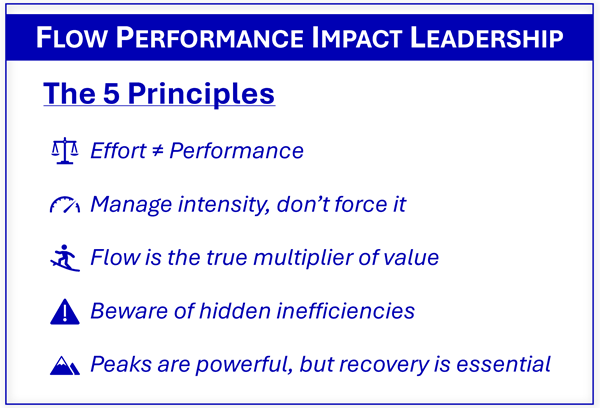
1. Effort ≠ Performance
Not all energy creates value. What matters is how effort translates into real impact for customers and the business.
➡️ In the model: constant Zone 5 effort looks intense, but delivers diminishing returns compared to focused Zone 2 work.
2. Manage intensity, don’t force it
In sports, athletes don’t train at full speed every day. They alternate intensity, focus, and recovery. Organizations must do the same: design rhythms that sustain, not exhaust.
➡️ In the model: leaders must design rhythms across Zones 1–5, avoiding the trap of permanent Zone 5 overload.
3. Flow is the true multiplier of value
Deep focus and fluid collaboration unlock the highest levels of creativity, quality, and delivery. Leaders need to protect and expand these moments of flow.
➡️ In the model: Zone 2 is where flow happens — uninterrupted time for deep work and value creation.
4. Beware of hidden inefficiencies
The silent killer of performance is wasted energy on low-value work disguised as productivity — status meetings, endless reports, and firefighting disguised as “being busy.”
➡️ In the model: Zone 3 is the “grey zone” — busy but stagnant, consuming resources without progress.
5. Peaks are powerful, but recovery is essential
Strategic intensity — launches, deadlines, transformations — drives results. But without recovery and renewal, performance collapses. Leaders must ensure peaks are intentional, rare, and always followed by rest.
➡️ In the model: Zones 4 and 5 represent peaks of intensity; they must always be balanced by Zone 1 recovery to sustain long-term performance.
Why this matters for leaders
These principles are universal. They work in sports, where athletes build their careers not on constant effort, but on intelligent cycles of training and renewal. And they work in business, where leaders must protect their organizations from the illusion of constant busyness.
The future belongs to companies that design sustainable performance systems — where effort is converted into value, not wasted in fatigue.
👉 As a leader, which of these principles speaks most to your current challenges?
👉 How do you balance intensity and recovery in your teams?

