

From Delay to Rhythm: How to create environments where team flow emerges naturally through a Human–AI framework that taps into intrinsic motivations, with the added benefit of increased productivity and engagement. If your first real feedback on a project only comes weeks after the kick-off, you’re in trouble but luckily in the right place.

A recent study (Innovation Flow: A Human–AI Collaborative Framework for Managing Innovation with Generative Artificial Intelligence) involving small, cross-functional teams in innovative settings using AI as a co-designer (29 projects, 142 participants), shows outstanding results: activities that used to take 3–5 days (e.g., brainstorming solutions, prioritization, prototype sketches) are now completed in 6–8 hours.
This is not because AI decided or acted or imposed tasks, but because it removed friction, suggested structured alternative techniques, and proposed challenges aligned with specific individuals or groups.
All this happens in minutes; humans retain the critical role of selecting and structuring the work context. In short: compressing a week into just a few days (if not hours).
|
In the previous post, “Fixing How We Think at Work — With AI,” we discussed how today’s work is heavily burdened by cognitive load, primarily handled by System 2 thinking (see Thinking, Fast and Slow), which is energy-intensive. AI can reduce this friction (micro-decisions, task switching, procedural steps), shifting the load from System 2 to System 1 (automatic, experience-based, less demanding), increasing the likelihood of flow emerging naturally.
Now, let’s extend the concept from the individual to the team.
From Individual Flow to Team Flow
Just as for individuals, team flow cannot be imposed.
However, we can design a context that facilitates it. That’s the primary goal of this post.
Moving in this direction requires two clear leadership choices:
- Let go of control and micro-management, and instead focus on enabling conditions: Challenge vs Skill, Clear Goals, Rapid Feedback, Responsible Decision Autonomy.
- Use AI as a facilitator that proposes challenges aligned with or slightly above team capabilities, suggests techniques and assets, while leaving decisions and responsibility in the hands of the team (human-in-the-loop).
Before diving into the core topic, let’s briefly recall the concept of the State of Flow:
It’s that state where the challenge is high enough to engage the person, but not so high as to create anxiety; this means skills are sufficient to feel capable, but not so superior as to slip into boredom. It’s best represented as a channel, not a precise point.
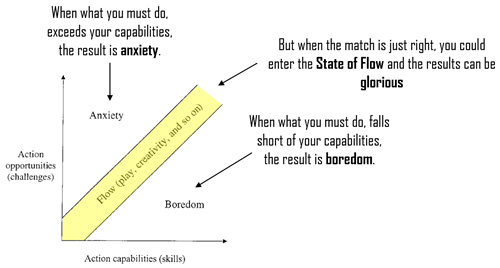
In work, as in sports, flow isn’t achieved by “pushing harder,” but by continuously calibrating challenge and skill.
This is where the approach used in the aforementioned study comes into play: it doesn’t force people into flow, but helps design the playing field to increase the chances that the team can enter that channel.
AI is used to reduce turbulence (fragmentation, indecision about techniques, downtime), seeking the best possible match with skills within the team, while leaders protect rhythm and quality.
How can you actually “navigate” the Flow channel?
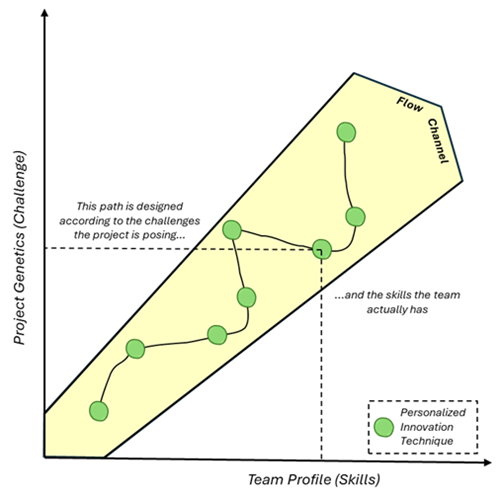
The illustration summarizes the idea: Project Genetics (PG) describes the “genetics” of the challenge (complexity, uncertainty, openness of constraints, risks, time-box); Team Profile (TP) captures cognitive and motivational diversity, skills, decision-making styles, and collaboration preferences.
By combining PG × TP, AI proposes, rather than imposes, tailored techniques and sequences, which the study calls Personalised Innovation Techniques (PInnT).
The team can then choose, review, and/or reassemble both the techniques and possible assignments to team members. The goal is to design an adaptive course that increases the likelihood of keeping the group within the flow channel: neither underloaded (boredom) nor overloaded (anxiety), but with a sustainable rhythm and immediate feedback.
The 4 Levels of the Framework
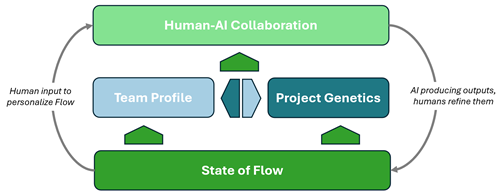
The framework architecture is based on four integrated layers that work like a relay, each with specific feedback loops:
- Psychological (State of Flow)
- Social (Team Profile)
- Contextual (Project Genetics)
- Techno-Methodological (Human-AI Collaboration)
1) Psychological: Designing the Conditions for Flow
It starts from flow theory: balancing challenge with skill, declaring clear objectives, and ensuring frequent feedback to reduce the latency between action and information. The intensity of work is not imposed, but sought by individuals: we create workspaces with a sustainable rhythm, where focus and attention can “naturally lock in.”
2) Social: Understanding the Team Profile
Here, cognitive and motivational diversity, decision-making styles, collaboration preferences, skills, and talents all matter. The final goal of the framework is to build a dedicated “map” that guides the AI in proposing techniques for specific roles, highlighting the right competencies at the right time.
3) Contextual: Coding the Genetics of the Project
Every challenge or project has its own complexities, uncertainties, constraints, time-boxes, and risk levels. Coding this “genetics” avoids one-size-fits-all recipes: AI helps hypothesize workload, sequence, and rhythm tailored to the context, preventing overload and burnout.
4) Techno-Methodological: Using AI as a Co-Designer
This is the enabling part. A multi-agent system capable of generating Personalised Innovation Techniques: starting from the project’s challenge, AI proposes variants of known techniques, designs operational steps, assets, and roles, provides theoretical justification (why this technique here and now), and finally suggests the necessary skills and who might take charge of those techniques.
The concept of human-in-the-loop is respected by definition:
AI proposes, the team critiques, reassembles, and chooses. When this happens, full execution autonomy, quality of discussion, and alignment with the context all increase.
What the Framework Is Not
Guiding teams into flow does not mean pushing people into a specific mental state on command.
Flow cannot be forced: you design the context so it can emerge naturally, thanks to clear objectives, frequent feedback, and a calibrated workload. This is not about a new kind of digital Taylorism: tasks and activities are not measured and managed by an AI acting as a policeman with a KPI whip.
On the contrary, the context is designed to ensure a sustainable pace and zero burnout. In this model, AI does not command: it is a co-designer that proposes techniques, alternatives, and materials; the choice remains human, as does the responsibility to reassemble what is needed for the specific context.
This is the ground on which team flow becomes possible, and sustainable.
Focus on the Use of AI in the Framework
The technical infrastructure used in the study is based on a modular AI Agent architecture (GPT-4.5, LangChain, RAG).
The workflow can be summarized in five main phases and 8 different Agents.
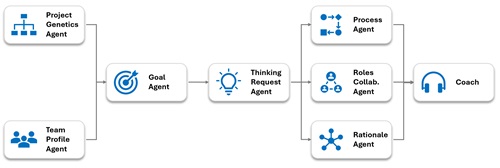
- Context Data Collection. Two Agents read the initial data: the Project Genetics Agent acquires and synthesizes the challenge parameters (complexity, uncertainty, constraints, timing) by drawing from its knowledge base; in parallel, the Team Profile Agent extracts guidelines on the team profile (decision-making styles, collaboration preferences, motivations). This phase uses RAG – Retrieval Augmented Generation: the AI “retrieves and reasons” on relevant knowledge, rather than improvising.
- Clear Objective. The Goal Agent receives input from the previous agents and translates the problem, time, and resources into a specific purpose with key results (OKRs). Here, AI acts as a “sparring partner” to eliminate ambiguity and align everyone.
- Technique Selection. The Thinking Techniques Agent, based on the objective and key results, consults a database of techniques and proposes a shortlist consistent with the project’s genetics and the team profile.
- Operational Personalization. The final part is carried out by three dedicated Agents to build the Personalised Innovation Technique: step-by-step process, roles and collaboration patterns (who to involve, how and when), materials, and theoretical justification, also using an innovation knowledge base.
- Guided Application. The human, with the support of a Coach (AI assistant), guides the execution, clarifies steps, and suggests micro-variants if obstacles arise.
How It Works “In the Field”
To visualize the mechanism, let’s imagine an Innovation Day with 6–8 people:
- Input to the system: objective, project genetics, team profile.
- AI generates 2–3 technique variants (PInnT): each complete with steps, roles, and materials, calibrated to the challenge versus skill balance.
- The team chooses and reassembles, critically evaluating the options (“critical filtering” pattern).
- Execution happens in short cycles, with immediate feedback and iteration.
- Only the essentials are measured: compressed time, avoided preparation, and the perception of clarity, engagement, and autonomy.
In observed cases, this flow led to a 58–62% reduction in preparation time (a direct proxy for coordination/meetings), over 60% acceleration in the initial phases, and a clear leap in clarity, motivation, and inclusion. In other words:
Fewer meetings to organize, more time focused on the work; more prototypes, more learning, and a shorter time-to-value.
Why It Works
- Reduces the “cognitive gear-shifting” cost: AI removes procedural micro-decisions (“Which technique should we use now?”) and frees up mental energy for meaningful work. This increases the likelihood of the team entering a state of flow.
It’s like a cyclist drafting behind teammates to benefit from the slipstream: same power and effort, but greater speed. - Improves feedback quality: The sequence proposed by AI makes learning immediate (with rapid alternation between divergence and convergence, typical of brainstorming and Design Thinking techniques). Less latency, more rhythm.
- Boosts autonomy and engagement: Contextual personalization supports correct execution of techniques and distributed responsibility. The team doesn’t just undergo the process, they co-design it.
Applicability Beyond “Pure Innovation”
The study originates in innovation environments (healthcare, manufacturing, education, public administration), but its message is transferable to agile teams facing new or high-uncertainty challenges: product, marketing growth, operations, customer experience.
The key is not the sector, but the ability to codify the genetics of work and adapt techniques in real time, maintaining a sustainable pace and human decision-making.
Here, leading means designing the playing field so that team flow becomes more likely, rather than chasing individual heroics.
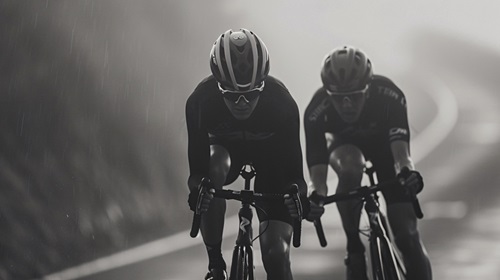
In the cycling metaphor, AI is the luxury domestique: closing gaps, carrying water bottles, keeping the pace high. But the breakaway on the climb or the sprint to the finish is, and always remains, human: choosing, reassembling, and taking responsibility.

